
On 5 January 2025, I wrote “President Javier Milei is running the world’s largest experiment in anarcho-capitalism. He is cutting red tape, shrinking government and (for now) appears to be reducing inflation to manageable levels. If he turns Argentina around, it will ripple across the world. It’s seldom that economists get to run countries, but here we have one and he is not holding back. I don’t know what will happen to Argentina, but the era of heavy-handed government interventions will start rolling back if Milei succeeds.” Let’s take stock.
When Milei took office in December 2023, he inherited an economy in which the state had progressively displaced the basic mechanisms of a functioning market economy. Fiscal deficits had become routine, money creation had become a financing instrument, exchange controls and import restrictions distorted decisions, and relative prices no longer reliably signalled scarcity or value.
Argentina’s post-Milei reform remains far from perfect, but it has demonstrated what happens when a government restores fiscal constraint, allows prices to adjust and begins to make investment a more rational proposition.
Our economy is not Argentina’s. Some important institutions are stronger, inflation is low and our monetary policy retains credibility. Do not be fooled by the mouth noises of our President, SA is moving in a more state-led direction just as Argentina is attempting to escape one. More tariff protection, greater localisation requirements, procurement designation, endless permits, and a firm belief that industrial policy can substitute for competitiveness.
Milei’s most significant achievement has been fiscal. Argentina moved from chronic deficits (2.9% in 2023) to a primary surplus of 1.4% of GDP in 2025. In SA we moved from a deficit of 4.9% to 4.5% for the same period. Milei’s adjustment involved cutting spending, reducing subsidies and ending the assumption that the central bank could indefinitely absorb the cost of government.
Argentina’s previous policy model rested on the illusion that government can spend resources without ultimately imposing the cost through taxes, debt, inflation or default. This delusional thinking led to a 200% annual inflation rate in 2023, but also many other bouts of terrifying inflation over the last century. Hyperinflation destroyed savings, shortened business planning horizons, distorted wage bargaining and imposed the heaviest burden on households unable to acquire foreign currency, inflation-linked assets or property (poor people).
Since Milei, annual inflation has fallen to roughly one-sixth of its 2023 rate, reaching approximately 33% by mid-2026. Monthly inflation fell to 1.9% in June 2026, though it remains far too high to regard as normal. Thank goodness, this is not a problem we need to contend with.
South Africa’s problem is fiscal drift combined with weak growth, growing public liabilities and insufficient, unproductive public expenditure. The 2026 Budget projects gross government debt at 78.9% of GDP in 2025/26, declining only gradually to 76.5% by 2028/29.
A country with South Africa’s unemployment rate, infrastructure deficit and weak growth cannot treat debt stabilisation near 79% of GDP as a sufficient achievement.

Argentina’s unemployment rate, despite worsening during adjustment, was 7.8% in the first quarter of 2026. South Africa thus carries a very large debt burden while producing less per person and excluding a far larger share of its population from work. In effect a very small group of people need to pay off this debt unless employment dramatically rises.
The case for market-led economics is not an argument for a powerless state. It is an argument for a state that performs the functions only it can perform effectively. Protect property rights, keep people safe, enforce contracts, maintain fiscal and monetary credibility, supply public goods (well!), police competition, secure infrastructure and create predictable rules (!).
Argentina’s “Régimen de Incentivo para Grandes Inversiones” (RIGI Regime) gives qualifying large investments a more stable tax, customs and foreign-exchange framework, particularly for energy, mining and infrastructure projects. Our own incentive schemes are unpredictable, commit almost all subsidies to one industry, and have done little to drive up new investment.
We can (and should) debate whether a special investment regime is preferable to a generally neutral, lower-cost tax and trade system, but Milei’s core logic is sound and ours is not. Capital will not commit billions of dollars where taxes, import access, and property rights are politically negotiable.
In SA, tariff increases raise costs for downstream industry, local-content requirements narrow sourcing options procurement designation elevates compliance over value, and failing state-owned enterprises divert resources from productive investment. Industrial policy is a mechanism for protecting incumbents rather than helping firms become internationally competitive.
But, Argentina’s adjustment has imposed real hardship. Unemployment rose to 7.8% in early 2026 (38% in SA). Poverty in Argentina remains severe, at around 38%, with SA sitting at 67% according to Stats SA.
State capacity matters. Fiscal discipline matters. But the route to higher living standards is not more discretion, more protection and more politically directed capital. It is a productive, growing economy in which firms can compete, invest, trade, and hire without depending on a minister, a government agency, a procurement designation or a bail-out.
Argentina may still stumble, but it understands that the government cannot create wealth. Only each individual, given sufficient freedom, can create that upward momentum.
Growth matters. Growth is the only mechanism that shrinks a debt ratio without austerity, absorbs new entrants into work, and widens the tax base that pays for policing, schools and electricity. Treasury projects real growth of about 1.6% in 2026, reaching 2% by 2028, barely ahead of population growth, which means income per person moves sideways for another decade. Argentina, from a far worse starting point, grew 4.4% in 2025. A country growing at 2% cannot employ the millions of unemployed, and no amount of designation, localisation or protection changes that arithmetic. Growth is not one policy objective among several. It is the precondition for all the others.
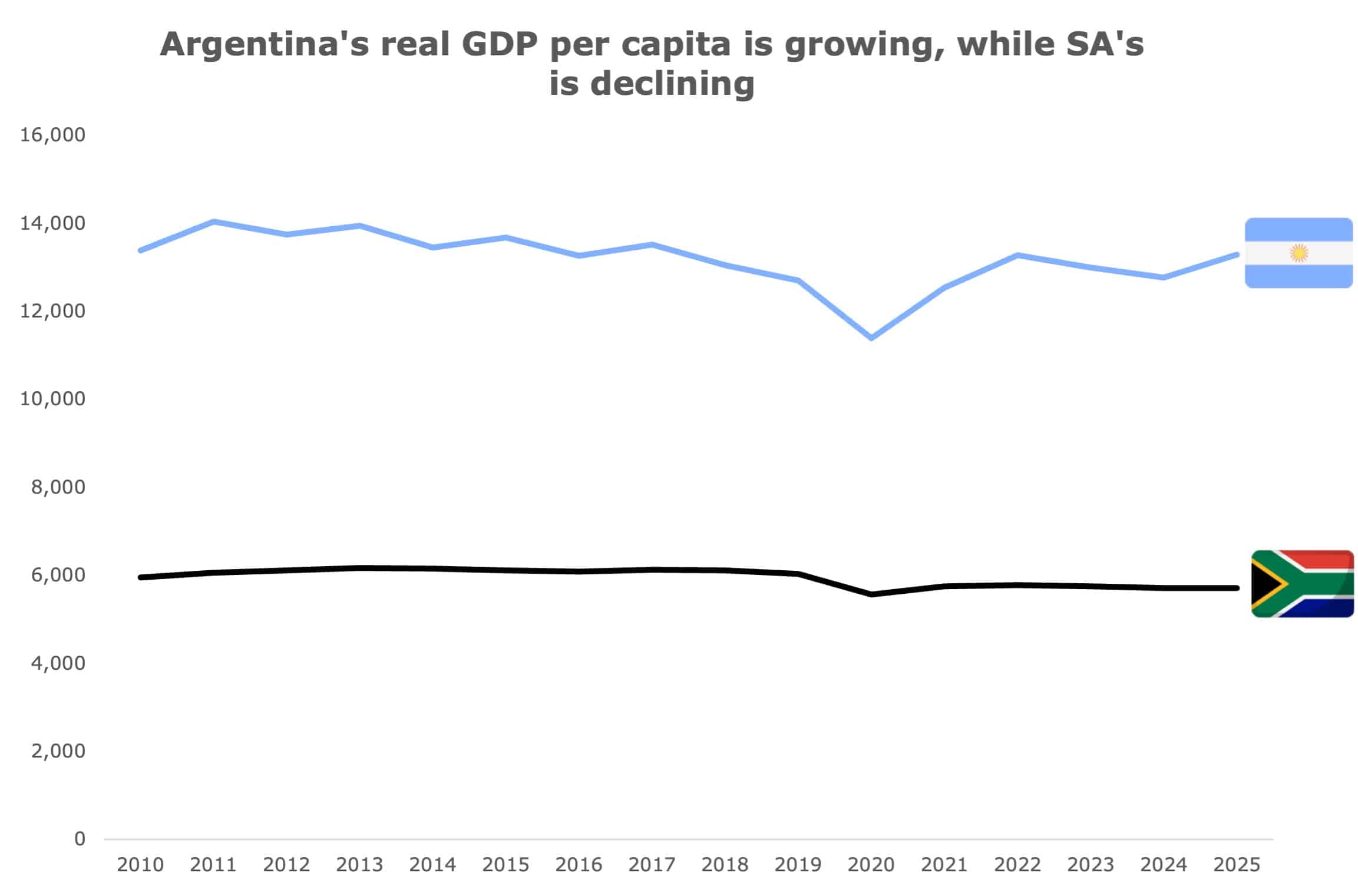
Here is the acid test. Do you think a child born today in SA will be better off in 30 years than their Argentinian twin? I know what I think.