
The ‘zombie tariffs’ we have been going on about might actually be dead. In a move that highlights the critical importance of up-to-date data in a tariff application, the International Trade Administration Commission (Itac) has effectively hit the ‘refresh’ button on a long-standing application (zombie tariff investigation) to increase duties on peanut butter. And no, this blog is not really about the peanut butter tariffs. There is a bigger issue at play here – the outdated/obsolete data problem.
The (scary zombie) backstory: A delayed decision
On 9 June 2020, RCL Group Services filed an application to increase the tariffs on peanut butter from 0.99c/kg to 25%. The investigation was initiated on 15 January 2021. The period of investigation for imports was 2017 to 2020. Comments were received from interested parties, who had four weeks to respond. Then nothing. And more nothing until on 25 July 2025, five years after the original application had been filed.
On 25 July 2025, Itac published a gazette, announcing a renewed application by RCL Group Services (Pty) Ltd to increase customs duties on peanut butter from 0.99c/kg to 25%. This was 4.5 years since this case had initiated. The period of investigation of imports for this reinitiation was 2021 to 2024. The Commission initially recommended the duty increase to the Minister of Trade, Industry and Competition, but the Minister referred the recommendation back to the Commission for ‘further investigation and consideration’.
Why the hesitation? The Minister raised specific concerns regarding the ‘price raising effect’ on a staple product for poor households, alongside questions about industrial capacity and the value chain. What we don’t know is why it took so long for the Minister to decide that increasing the import duties on peanut butter would cause its price to rise.

A lot happened in the period between when the original investigation initiated and when the new case replaced the old application. Let’s begin with how the effective rate of duty eroded by 38% between 2017, the start of the investigation period for the first investigation and 2024, the end of the investigation period for the second investigation. The current duties on peanut butter are set at R0.99 per kg, which began as an effective 4.07% in 2017 and dropped to an effective 2.51% in 2024. The line on the adjacent chart is the effective rate of duty on peanut butter and you can quickly see how this value has degraded over the period. The blue area chart is the amount of duty which would have been collected if a 25% had been in place and the orange is the amount of duty actually collected in that period. The gap is very big.
I am not justifying a duty increase. I am simply showing what would have happened if the duties had been imposed within the six months of initiation (the period promised by Itac to take a decision on a tariff application).
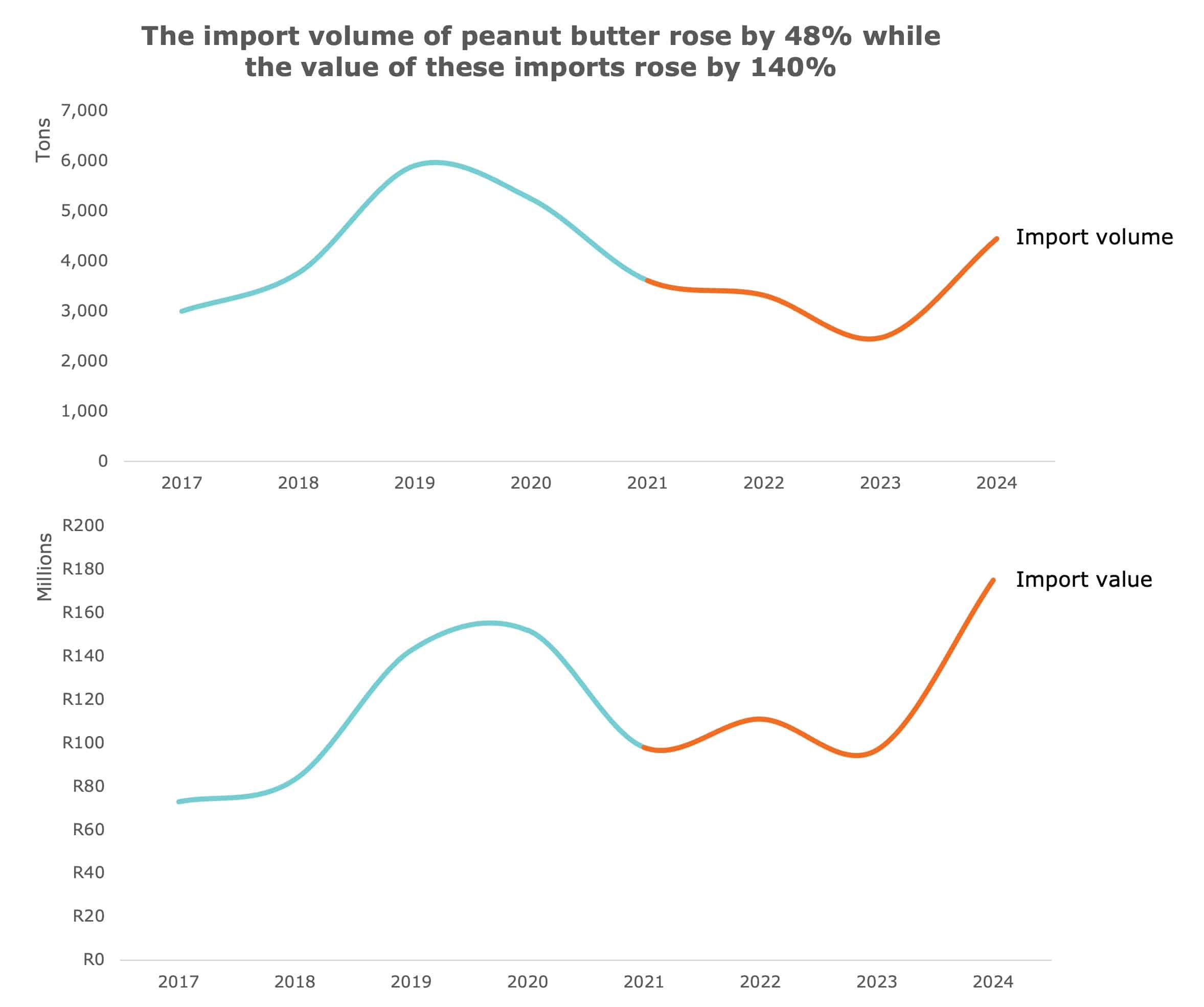
Although the volume of imports rose by 48% over the period, the value of these imports rose by 140%. The price of peanut butter had risen materially over the period. The applicant benefitted to some degree from these price increases because despite their volumes dropping by 16% in the last three years, their revenue earned from these sales rose by 13%.
According to the most recent application, they lost 10% market share to imports in the last three years, which is a lot.
Employment fell by 16% in the most recent period, but also fell by 4% in the original period (2017 to 2020), so this is significant.
The concern around peanut butter prices rising if the duties are increased in likely correct, so if that concern persists, its not obvious what could be said in a new application which could change that, unless of course the applicant needed to commit to cap price increases in the reciprocal agreement they needed to sign before the matter was initiated.
The Call for ‘Fresh’ Data
A lot has changed between when the first application was filed with Itac and when the Minister referred the investigation back to Itac. The primary difference between the two applications is the structural argument regarding input costs.
In the 2020 application, the major cause of injury was low-cost Indian imports undercutting local prices. Import volumes increased from 1.1 million kg in 2017 to over 4 million kg in 2020.
The 2024 application is different. Recognising this, the Commission then requested an ‘updated’ application from RCL Foods, including updated market, trade, and financial data. This request for updated data matters because 2024 application heavily emphasises a tariff structure anomaly: local producers pay a 10% duty on raw material imports (groundnuts), while finished peanut butter enters duty-free, making local manufacturing uncompetitive. According to the application, imported peanut butter has already replaced almost the entire market for local manufacturing of white labelled peanut butter.
The ground nut debacle
The whole peanut value chain has been ravaged by tardy tariff decision making. On 15 January 2021, an investigation was initiated for a customs tariff increase on roasted groundnut imports classifiable under subheadings 2008.11.20 and 2008.11.90 from 0.99c/kg (0.033% ad valorem equivalent) to 20%. In August 2024 (3.5 years later!), ITAC request updated information from the applicant after the investigation was referred back to the Commission by the Minister (see the theme developing?). On 7 March 2025 (50 months after initiation), the application was withdrawn by the applicant because they had closed their nut roasting business. The reason provided in the withdrawal gazette sums up the situation perfectly:
“[The] applicant was influenced ostensibly by a range of operational and other factors, including but not limited to the prolonged uncertainty surrounding the decision on the amendment of the customs duty. The applicant alleges that such uncertainty has affected the viability of their business model.”
This updated peanut butter application is thus quite significant. It is Itac confirming that data used in an investigation can become outdated and obsolete if a decision is not made and implemented within time.
Why ‘Recency’ Matters
The Commission’s decision to ask for updated data is not just a procedural formality; it is the law. The High Court in Mings Distributors CC v International Trade Administration Commission and Another (A5068/2018) [2019] ZAGPJHC 458 (11 November 2019) para 9, in respect of rebate applications, recognised the need for ‘updated’ information when four years had lapsed since the information was considered by Itac. This is just clearly Itac’s duty – they must use recent data in all tariff investigations. It is not discretionary.
It is also a matter of administrative fairness. It is an issue that is currently plaguing all the Itac tariff investigations that have not been completed in due time – the so-called ‘zombie tariffs’.
I have previously examined the ‘recency of data’ in Itac trade remedy investigations. I have explained that the WTO has found that while historical data is not inherently unreliable, the use of outdated data to make forward-looking economic decisions, like imposing duties for the next five years, can lead to inaccurate dumping margins or injury determinations.
For a decision to be administratively just and rational, it must reflect the current economic reality of the Sacu industry, not a snapshot from years ago.
The ‘Zombie’ Problem
As I have said above, the delay in this peanut butter case is symptomatic of a wider trend and problem we have identified in our seven ‘Import Duty Investigation Reports’. In these cases, we have highlighted the problem of what these ‘zombie tariffs’, i.e., investigations that remain open for years, far beyond the prescribed turnaround times. Our reports note that when investigations drag on for 20, 30, or even 60+ months, the data on which they were founded essentially rots. So, what is the issue here?
The Risk: Decisions made on old data may protect an industry that no longer exists in that form or punish importers for market dynamics that have since corrected themselves.
The Fix: By forcing a refresh of the data, as Itac has done here with RCL Foods, the Commission avoids the ‘tariff zombie’ trap. They are ensuring that if a duty is imposed, it is because the current domestic industry is suffering current injury.
What does this all mean?
The peanut butter Gazette is now effectively a new investigation. The arguments from 2021 are likely obsolete. If this is the case in this investigation, which is not the worst of the ‘zombie tariffs’ in relative terms, this means that all the existing ‘zombie tariffs’ investigations must all be terminated, or Itac must, as it has done on peanut butter, reissue the Initiation Gazette and ask for fresh or new data.
Itac, by reinitiating the peanut butter tariff investigation, has explicitly and expressly confirmed that all the existing ‘tariff zombie’ investigations are irrevocably flawed because they are all using outdated or obsolete data. This means that if the investigations are not terminated or a request is made for fresh data, then all the findings in these investigations are fatally flawed. The findings would be immediately irrational.
Itac must also commit to completing all tariff and trade remedy investigations within a specific period. The same commitments must be made by the Ministers of Trade and Finance.
Long term, the real concrete fix must be in the International Trade Administration Act (ITA Act) and its Amended Tariff Investigations Regulations (ATR). The ITA Act and the ATR must be amended to say that the tariff investigations, including the Ministerial decisions, must be completed and implemented within 6 months, and in exceptional circumstances, in no more than 12 months.